Thursday, January 10, 2013

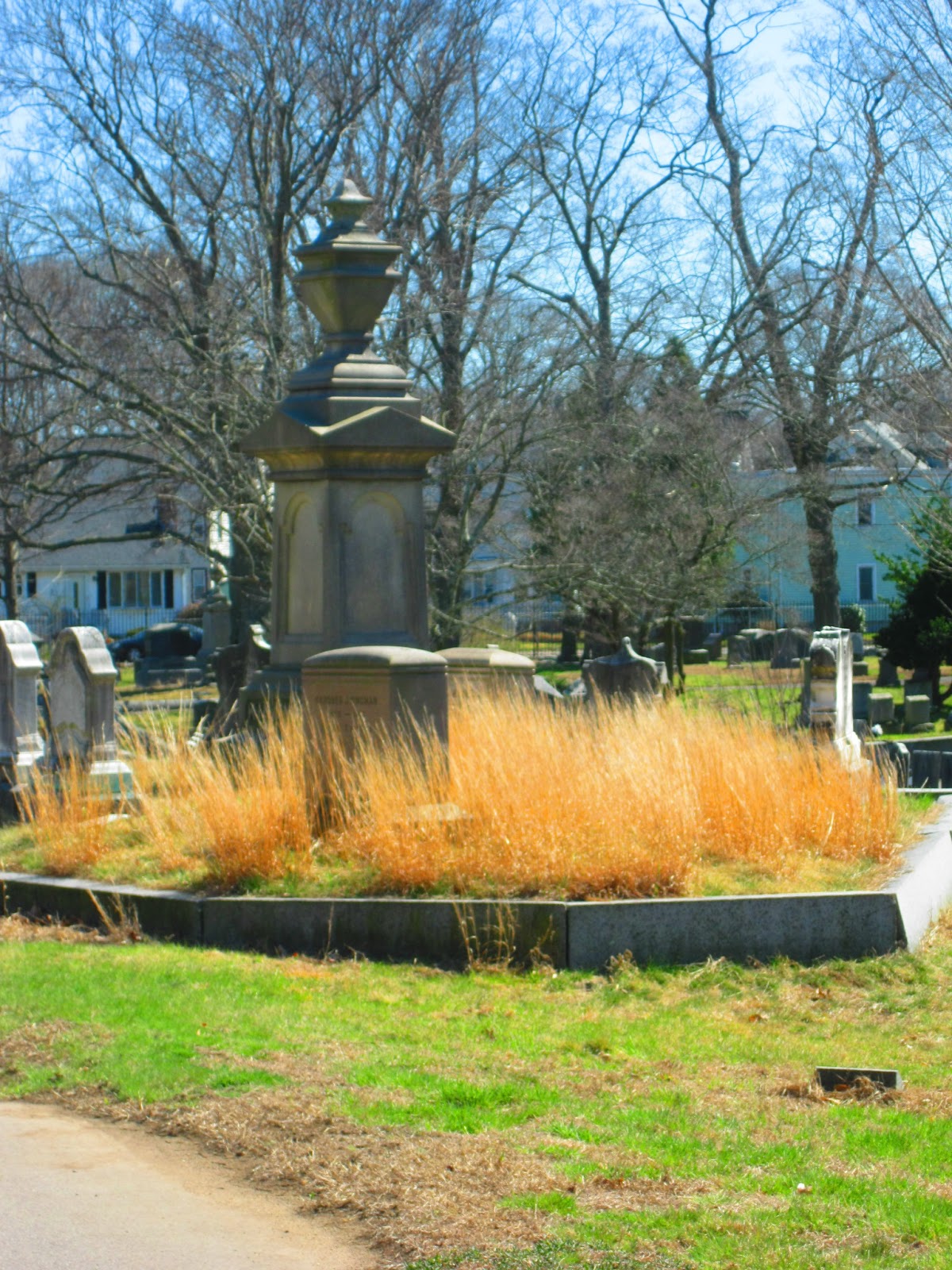
UNION CEMETERY, BROCKTON MA., 31MAR 2012

The Union Cemetery is located on the east side of Brockton, Ma. between
Center (Rte123) and Lyman Streets overlooking the George G Snow Park.
It's laid out in the Mt.Auburn Cemetery style popular in the mid to late
19th century, and like many cemeteries from that era an urban neighborhood
has sprung up around it in the 20th century. There are many Packards, Keiths,
and Dunhams buried here who probably are my distant cousins.


Wednesday, January 9, 2013

OLD BURYING GROUND, KINGSTON, MA: SYMBOLS & AN ENT

There are a number of  old gravestones at the Old Burying Ground with
 interesting designs & motifs. Some I recognize, others were new to me.


Urn & palm tree at the top of the stone.


Larger urn & palm tree


This next one is a bit more elaborate. The figure in the left hand oval has a circle
of life in her right hand, an hour glass in her left. In the right hand oval the figure
has the hourglass in her right hand a book (a Bible?) in her left.


Angel

A tower?

A broken chained circle.


Besides the symbols there was something I noticed about some of the
headstones at the Old Burying Ground:some of them were turning a
pale red or pink color. Some were just streaked, and others completley
stained. There were about a dozen altogether. Here are two examples:

I had never seen this before and had no idea what was causing it. So I
posted some of the pictures to the Association of Graveyard Rabbits
Facebook page and asked if anyone there might know. Lorinne Massey
suggested it could be tannin from the pine trees on the grounds combined
with rainfall to coat the gravestones. Considering all the stained stones
are located near or directly under the pine trees, it seems to me a logical
explanation.

Finally, one last shot: an ent like tree seems to be pondering the  meaning
of it all, or perhaps is calling for silence:


Monday, January 7, 2013

OLD BURYING GROUND, KINGSTON, MA. 3MAR 2012

The Old Burying Ground in Kingston Massachusetts is located behind
the First Congregationalist Church at 221 Main St (Rte 106). Entrance is made
around the corner from Green St. The gravestones, dating from the late 18th
century on to the present lie in the shade of a grove of pine trees.


There's some classic New England gravestone styles that I'll share next.

Sunday, January 6, 2013

COHASSET CENTRAL CEMETERY:THE ST. JOHN'S CROSS


((As I said in the last post, there's a story behind the large Celtic Cross
at the crest of the hill in the Cohasset Central Cemetery. I originally
wrote about this last March for a St. Patrick's Day post at my genealogy
blog, West in New England))


I've written before about the way some work of chance leads me to
encounters with places related to my family's history. Last month
I took some pictures in a local cemetery that I thought might make a
good St Patrick's Day post, a reminder of the perils our Irish ancestors
braved to come to America. But when I researched the story behind
a stone monument, I didn't realize that while I was not related to the
deadf it commemorated, I was connected to it in another way.


A tall Celtic cross sits atop a small hill in the midst of the Central Cemetery in
Cohasset, Ma, overlooking a tidal pond. On the landward side is the
following inscription:

This Cross Was Erected And Dedicated
May 30th 1914 By The A.O.H. And The L.A.A.O.H.
Of Massachusetts To Mark The Final
Resting Place Of About Forty Five
Irish Emigrants From A Total Company
Of Ninety Nine Who Lost Their Lives
On Grampus Ledge Off  Cohasset
October 7, 1849 In The Wreck Of The
Brig St.John From Galway Ireland
R.I.P.


Edwin Victor Bigelow gives the details of the wreck of the St.John in
his A Narrative History of the Town of Cohasset, Massachusetts, published
by the Cohasset Town Historical Commission in 1898:

On Sunday morning at seven o'clock, October 7, 1849, under a heavy northeast
storm, the British brig St. John, loaded with immigrants brought from Galway,
Ireland, was driven upon Grampus Ledge near Minot, and ninetynine lives
were lost. Another brig, the Kathleen, had managed to creep into the mouth
of our harbor and to anchor; but the St. John was farther out where the gale
struck furiously and made her drag anchors.

The masts were cut away, but still she dragged on. After the first heavy thump
on the Grampus Rock the old hulk rapidly tumbled to bits. Previous to the
breaking up, the jolly-boat was hanging by the tackles alongside when the
stern ringbolt broke and she fell into the waves. Captain Oliver, the second
mate, and two boys jumped into her to clear her, when about twenty-five
passengers poured into her and swamped her so that all perished but the
captain. The first mate hauled in the captain, who caught the end of a rope.

Then the longboat was loosed and the captain with the first mate and eight
of the crew and two passengers scrambled into her, reaching shore at the
Glades. Many more passengers were drowned in their desperate endeavors
to get into the longboat which saved the captain and crew. Ten others, upon
a piece of the deck which was wrenched off by the waves, were floated
safely to shore, seven men and three women.

The St. John was only an hour in tumbling to pieces under the incessant banging
of the waves upon her. Ninety-nine lives were lost and twenty-two were saved.
One of the survivors was a young woman who afterwards settled in Cohasset,
marrying a man whose name was by strange coincidence St. John. (pp463-464)


You can also read about the aftermath of the wreck by no less an author than
Henry David Thoreau who happened upon the scene the day after the storm
as bodies were being recovered and buried by the townspeople of
Cohasset. His account of the incident can be found in his book On Cape Cod.

Now we come to the coincidence:

The wreck of the St John took place while construction was being completed
of a lighthouse at nearby Minot Rock. On page 463 of Bigelow's book, just
before his recounting of the tragedy, there is this on the lighthouse:

"It was finished in the fall of 1849, and Isaac A. Dunham took charge of it,
lighting the lamp for the first time on December 13, 1849."


Isaac Dunham was the first Keeper of Minot Light. Even though it was not
in service at the time of the storm that sank the St John, he was present in
Cohasset and part of the group dealing with the aftermath. He stayed 
at Minot Light only ten months, resigning in 1850 because he felt the
structure was unsafe. A year later the first Minot Lighthouse was destroyed
by a terrible storm, taking the lives of two men stationed there.

My great great grandmother was Florilla Dunham, and while I haven't figured
out how we're related just yet, in all probability Isaac Dunham is my distant
cousin.     

And I wouldn't have known about him except for taking these pictures in
the cemetery in Cohasset, and then using two of them for a St Patrick's
Day post!

Saturday, January 5, 2013

COHASSET CENTRAL CEMETERY, COHASSET, MA. 22FEB 2012

The Central Cemetery in Cohasset, Massachusetts is located at the corner of
North Main Street and Joy Place. It stretches down the hill along Joy Place
and the lower section is bordered on the east by an inlet from the Atlantic
Ocean. I worry that that section is in danger from storm tides and flooding
at some point in the future. The upper section is hilly and might present a
challenge to some visitors.

Gate on North Main Street.,
Looking down from North Main.


Looking back from the central hill towards North Main Street.
Looking down from the central hill towards the inlet.
View from the columbarium at the top of the central hill.
 
There's a story about that cross. 
The earliest burials here date from 1705.
As I mentioned in one of the captions there's a  story behind that large Celtic
at the top of the hill, and I'll discuss that next.

Friday, January 4, 2013

TWO YEAR OLD RABBIT

Today is the second blogiversary of The Old Colony Graveyard Rabbit. One
of my New Year genealogy resolutions was to do better posting here and
uploading pictures to Find A Grave than I did last year. I'm happy to say I've
already succeeded on both. But just because I have doesn't mean I should
stop now.I have plenty more pictures to share.


So here are three photos from three different cemeteries I visited last Spring.
I'll be posting about those visits later. Does anyone recognize these three
South Shore Massachusetts town cemeteries?


Thursday, January 3, 2013

HIGH STREET CEMETERY, HINGHAM MA, 20FEB 2012 PT2

The third item of interest (to me, at least) at the High Street Cemetery is a
five sided monument directly across from the Whiting Chapel. On each
side there are one or more plaques of two types. One type is round and
contains the names of members of the Murdock family; the other type
rectangular with quotations, mostly from popular 19th century poems.
I did a Google search for their sources and I've put those I found
in parentheses after the quotes

The first two sides that I photographed had mo family name markers but
had two of the rectangular plaques each, one of which was set at an angle
across the monument. I think it was that odd position that caught my
attention. I'm displaying the sides in the order in which I took the pictures

Side 1


     The plaques read:
Top:
 "I wonder if ever a song was sung
But the singer's heart sang sweeter?
I wonder if ever a rhyme was rung
that the thoughts surassed the meter?
I wonder if ever the sculptor wrought,
till the cold stone echoed his ardent thought
or if ever a painter, with light and shade,
the dream of his inmost heart betrayed."
                                   ("I Wonder"-Anonymous)

Bottom:
"The inner side of every cloud
is bright and shining;
I therefore turn my clouds about,
and always wear them insde out
to show the lining."
                                         (James Whitcomb Riley)

Side 2

Top:
"I wonder if ever a rose was found
and there might not be a fairer!
Or if ever a glittering gem was ground
that we dreamed not of a rarer!
Ah! Never on earth do we find the best
that it waits for us in a land of rest 
and a perfect thing we shall never behold
till we pass the portals of shining gold."
                                         ("I Wonder"-Anonymous)

Bottom:
"Say not "welcome" when I come,
say not "farewell" when I go;
for I come not when I come
and I go not when I go;
for a welcome ne'er I give you,
and a farewell would never say."
                                          ("Always With You"- Shirley de Forrest)

Side 3

Name:
Walter A. Murdock
          Born
     May 8, 1869
          Died
     Aug.25, 1902

The Quotes:
Top:


"Nature is as true to herself in
all future ages as in the past"

"The Bible has been and will be
the educator of the world"

"Our Lord's Prayer is our guide.
If my amendment is accepted.
as we (ought)forgive."
A.L.M.

Bottom:
"The wind has a thousand eyes
and the heart but one;
yet the light of the whole world dies
when love is done."
                            (Haven't found the origin of this yet)

I couldn't find any sources for the quotes on the top plaque were
taken by writings or speeches by a member of the Murdock
family which would explain the initials "A.L.M."

It wasn't until I was preparing this post that I realized I had lost the picture
of the fourth side somehow. You can see on the far right edge of the side
3 photo that there are three of the round name plaques on the missing side
so I suspect that was the front side of the monument.

The fifth side has a missing diagonal plate. You can see the holes drilled
in the monument where it was fastened to the stone:


Side 5

The name:
Albert W. Murdock
           Born
    Nov.15 1855
           Died
    May 27 1903

Bottom:
"Oh, when I am safe in my sylvan home,
I tread on the pride of Greece and Rome.
And when I am stretched beneath the pines,
where the evening star so holy shines.
I laugh at the lore and the pride of man,
at the Sophist Schools and the learned clan;
for what are they all, in their high conceit,
when Man in the bush with God may meet."
                         (Good-bye, Proud World!" -Ralph Waldo Emerson)

One of these days I hope to make it back to the High Street Cemetery and
see what was on that fourth side.